When is the last time you bought a lottery ticket and thought to yourself: 'I am going to stop working if I win the grand prize'. How do you know that the prize money is enough to sustain your retirement lifestyle?
Have you ever wondered how much money is required for you to achieve independence?
Max also faced the same problem when drawing up his Masterplan to retire by 40.
Not knowing the size of your retirement gold nest is akin to running a race without knowing the finishing line. You cannot plan for it and spread your resources, and most importantly, you will forever be in the race.
In this post, I am going to share my personal guideline on the retirement savings required for financial independence. You may be surprised that the amount required may not be as much as you thought. But first, let's discuss some of the guidelines others are advocating.
Showing posts with label financial independence. Show all posts
Monday, 17 April 2017
Thursday, 16 February 2017
Understanding the Financial Independence Model | part 1
Followers of this financial blog would know that Max has been working on the Financial Independence Model (FIM) since the beginning of 2017. In a nutshell, the FIM is designed to help individuals compute their personalized FI age, based on basic financial information provided by the user.
For readers who are new to the FIM, a more detailed post on the main functions and principle of the model can be found in the post here.
So far, Max has tested the model with financial input from over 10 readers, with reasonable and logical output achieved. Below is the feedback from one reader who has found the model useful. It gives myself a great sense of satisfaction to develop a fully functional model that is useful.
However, as with all models in the world, the FIM output is computed based on a pre-defined set of formulas and rules. To be confident that the financial output is applicable to yourself, it is important to understand the modelling rules and assumptions of the FIM.
In this post, Max will describe in deeper details on the modeling principle of the FIM.
*Note: Input for the FIM is identified in blue for the remainder of this post
Objective of FIM
There are a few simple formulas out there we can use to compute our FI age. One popular method can be found here from Mr. Money Mustache, which states that the years to reach retirement is dependent on your saving rate as a percentage of your take-home pay.
This quick calculation by Mr. Money Mustache is very useful for anyone who wish to have a rough sensing of their years to retirement, but may not be ideal for someone who wish to plan out their retirement road-map in more details.
This is also the fundamental reason why Max decides to develop the FIM. Afterall, our retirement road-map should be unique to ourselves to be executable and achievable.
Objective of the FIM: Compute minimum retirement age based on customized financial input, with in built financial principles in Singapore's context.
Principle of the FIM
The overall flow of the FIM modelling rules is pretty straightforward, but may take some time to digest.
In brief, the model takes in all the expected income and spread them across the various baskets of cash equivalents after accounting for expected expenses and CPF contribution.
Upon FI age, the cash equivalent will be drawn upon to sustain the retirement life, which will be supplemented by the CPF savings at the later stage of our retirement.
The basic principle is to ensure that the pool of savings accumulated is sufficient to sustain the retirement lifestyle until the last age (to be determined by user), as compared to letting the savings last forever, which is practically impossible due to inflation.
The income and expenses are one of the most critical input to the FIM. Someone who expects zero expenses for the rest of his life can in fact retire yesterday. On the other hand, someone who has a higher annual expenses than annual income can forget about retirement altogether.
Expected income:
- Employment income - determined by monthly gross income and annual bonus, which will be increased yearly based on the annual increment rate, with annual contribution until the age of FI.
- Additional income - which user can input to capture one-off income at specific year, or repeated supplementary income that has a corresponding time validity.
Expected expenses:
- Basic/ survival expenses - are regular and recurring in nature, which will be increased based on inflation rate. Basic annual expense has no time frame, and will continue indefinitely until end of modeling age.
- Additional expenses - similar in concept to additional income
| Additional income/ expense table for user to customize their income/ expenses |
Allocation of cash equivalent
The two main categories in the model are cash equivalent and CPF savings, which are the two main form of savings to support our retirement plans.
Cash equivalent are further grouped into the following baskets:
- Emergency fund - to be maintained at percentage of annual basic expenses earning risk-free interest rate. E-fund will be set to zero after age to stop maintaining E-fund (which is usually the FI age).
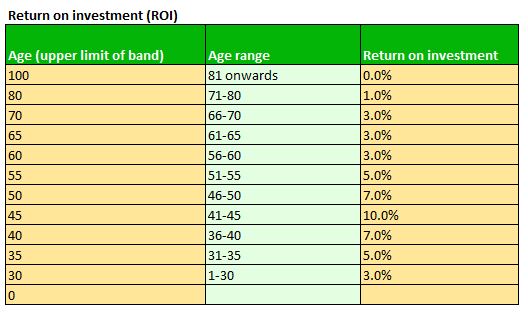
- Investment (cash) - investments that can be converted to cash to finance expenses when necessary, earning profit based on ROI table.
- Investment (SRS) - investments using savings in SRS, earning profit based on ROI table. The combined investment in cash and SRS will be maintained at percentage of 'investible' fund, to be cap at maximum investment sum.
- Savings - remainder of cash equivalent that is not kept as E-fund or invested, earning basic interest rate.
Relationship between the investment (cash) and investment (SRS) will be elaborated in another post.
The allocation of cash equivalent to the various baskets can be easily customized to match individual's financial preference, risk tolerance and investment proficiency. This can be seen from the large number of variables that can be adjusted by users.
For example, the ROI table below allows user to set different ROI at different age range.
Non investment savvy people can also set the percentage of 'investible' fund to zero, to allocate all the cash to savings.
| ROI table for user to customize their investment profit |
CPF savings and schemes
CPF is the other main category of saving for the model, which is why the FIM is very applicable in our local context. The CPF is an integral part to our retirement, so the FIM will not be complete without building in the CPF concept.
Interest earned from each of the accounts is also modeled based on the CPF interest rates, which also include the extra interest and additional extra interest for eligible CPF savings. More details is available on the CPF website here.

CPF allocation rate, extracted from CPF website
Users can also decide whether to maintain their CPF at the full retirement sum (FRS) or the enhanced retirement sum (ERS) at age 55.
In general, the sum keep in CPF RA account will earn an annualized rate of return of about 5% to 5.5%, so if your ROI is below this range, the better option will be to keep the CPF savings at ERS.
The estimated annualized rate of return for CPF RA savings will be elaborated in another post
CPF savings and schemes
CPF is the other main category of saving for the model, which is why the FIM is very applicable in our local context. The CPF is an integral part to our retirement, so the FIM will not be complete without building in the CPF concept.
Interest earned from each of the accounts is also modeled based on the CPF interest rates, which also include the extra interest and additional extra interest for eligible CPF savings. More details is available on the CPF website here.
| CPF allocation rate, extracted from CPF website |
Users can also decide whether to maintain their CPF at the full retirement sum (FRS) or the enhanced retirement sum (ERS) at age 55.
In general, the sum keep in CPF RA account will earn an annualized rate of return of about 5% to 5.5%, so if your ROI is below this range, the better option will be to keep the CPF savings at ERS.
The estimated annualized rate of return for CPF RA savings will be elaborated in another post
As the ERS and FRS in the future will be much higher than the amount today ($166k and $249k as of Jan 2017), the FIM has an in-built function to extrapolate the estimated FRS and ERS amounts at user's 55 year of age, based on the historical rate of increase for the past 15 years.
Any withdrawal from CPF savings at age 55 and CPF LIFE payment at age 65 will be contributed towards the cash equivalent pool.
Another key usage of the CPF is the public housing scheme (PHS). User can input their own BTO-related variables such as the downpayment sum and the BTO monthly installment (using CPF OA) to determine the utilization of the CPF OA account towards housing.
Initialization of FIM
The model requires a 'start state' to commence modelling, so users are required to provide their financial status for their current age. These include the
- current cash equivalent,
- current CPF balance (in each of the OA, SA and Medisave accounts),
- current annual gross income and expenses, and
- current SRS balance
Testing out the FIM
I have created a sample input here for Imaginary Joe, whom based on the FIM output, can retire in 7 years' time using a hypothetical financial input.
If anyone would like to receive their customized output using the FIM, please feel free to contact Max using the contact form here.
Sharing is caring, isn't it.
If anyone would like to receive their customized output using the FIM, please feel free to contact Max using the contact form here.
Sharing is caring, isn't it.
To be continued on part 2...
----------
MAFIA
----------
----------
Related posts
Saturday, 21 January 2017
Do you have a plan for early retirement?
Achieving financial independence (FI) is the dream of many working adults. We dream of lying on the bahamas beach sipping watermelon juice. We plan to devote our time to charitable acts. We want to chase our passion, to do the things we love, instead of the things we need to. Basically, we want to stop exchanging our life (time, effort and energy) to live (our desired lifestyle).
Regardless of what is the kind of life you want to lead upon FI, one thing is for sure: we need to have a personal plan for achieving financial independence.
A plan for achieving FI is like a blueprint for building a house, a recipe for cooking a dish, and a strategy for completing a marathon.
The plan has to be personal, custom made and prepared by yourself. There is no better person than yourself who can craft your ideal financial freedom blueprint. After all, everyone has different aspiration, lifestyle, beliefs, capabilities, values and outlook in life. The point is, everyone is unique, hence, a perfect plan for someone will most probably not be suitable for another person.
Most of us has a rough plan
Yes, everyone who is reading this post should have in a way thought through their own retirement plan (otherwise you wouldn't have spent the last 30 seconds reading my introduction). It may not be very structured, but generally we all should have a general 'plan' in our financial journey.
For example, most of us knows
- the age we want to retire
- the expected big expenses in each phase of life
- the amount of expenses required to incur each year
But, it is not so straightforward to know how much is enough. It will be disastrous to quit your job and lead a 'retirement' life, only to realize later that you don't have enough for old age.
The strategy in Max's financial journey
In general, the financial journey for each person can be classified into a few phases, bounded by key milestones. For Max, there are 4 main phases, each categorized by the different income generation and/or financial needs.
Phase 1: Wealth accumulation (current to FI)
Phase 1 is characterize by a rapidly increasing cash equivalent and CPF savings. This is the period when Max focus on wealth accumulation from employment income and investments. The CPF is another key area Max will actively manage to optimize the CPF returns at age 55.
The objective here is to amass a sum of cash equivalent that is sufficient to support expenses till old age. Similarly, the CPF account should be built up sufficiently to help support retirement expenses in the form of CPF LIFE payout.
Phase 2: Sustainable lifestyle (FI to CPF withdrawal age)
The achieving of FI signifies the commencement of phase 2, the post working life. Without employment income, the main income will come from investments returns, currently set as 5% per year. The focus here is to manage expenses in a sustainable manner without compromising lifestyle quality. If someone has to scrimp and live like a beggar during this stage, he might as well get out and work for another few years.
Max does not foresee himself relying solely on investment income to sustain his expenses during this period. However, the plan currently is designed based on zero employment income, so any additional income during this phase will be an added bonus.
Phase 3: Self management (CPF withdrawal age to CPF LIFE payout age)
The CPF savings above minimum sum can also be withdrawn as cash at this stage. While the plan is to make this withdrawal at age 55, Max's plan may change according to how confident he is with his investment returns.
At this point, the sole source of income will be from investment returns. So it is important for Max to be disciplined and careful, both in terms of managing his portfolio and expenses.
Phase 4: Golden age (CPF LIFE payout age to end of financial journey)
CPF Life payout will commence at age 65 to supplement the investment income, the latter is likely to be much lower as we grow older. Max definitely does not have the confidence that he can maintain the same ROI as he age. Again, the plan is built based on the worse case scenario, so any additional returns will be a bonus.
The Financial Independence Model
The two graphs above are generated by the Financial Independence Model (FIM) developed by Max. By keying in basic information on income, expenses and investment, the FIM is able to determine the age of achieving FI. From the graphs, it is not difficult to see the 4 phases in Max's financial journey, and FI will be achieved by age 40!
Max will be writing more on the FIM after it is fully tested. If you would like to test out the beta FIM to generate the same graphs for yourself, just link up with me.
What is your plan?
Many of us may have more than 4 different phases in their financial journey. For example, for couples who have kids, they will go through a phase with higher expenses to raise the children. Another example will be for people who is able to generate side income, such as rental or online business.
Regardless of how many phases there are, we want to ensure that the wealth built up is able to sustain our expenses in the future. Only then we can truly be eligible to say that we have a plan for early retirement.
----------
MAFIA
----------
----------
Upcoming posts
2. Do you have a plan for early retirement - posted on 21 Jan 2017
3. My financial philosophy
4. Review of my 2016 stock investing performance
5. Why do I top up my CPF SA using cash
6. Big spending - Invisalign
Saturday, 14 January 2017
Should I transfer money from OA to SA account?
One of the key aspect to achieving early Financial Independence is to optimise the returns of your wealth. However, many people focuses primarily on building up their cash bags and neglect the other bulk of their savings, the CPF.
Although our CPF savings cannot be withdrawn before the age of 55, it is important to start acting early, to take advantage of the risk-free interest rate on our CPF savings. One of the available CPF schemes is to transfer OA savings to SA account (OA-SA transfer).
What is the difference between OA and SA account?
Unless you have just started receiving periodic contributions to your CPF, you deserve a knock on the head for asking this question. Nonetheless, Max has created a simplified poster below to highlight the main differences between the two accounts.
In the discussion to accelerate growth of your retirement savings, the higher interest rate earned by the SA account is the key variable to the equation. In return, we give up flexibility as the SA account cannot be utilize for Housing and Education, which are two big expenses we cannot ignore.
In case I need it (ICINI)
Stop using 'in case I need it' as an excuse, this is the main killer to optimisation of wealth. The same meaning as 'in case' is 'I did not plan'.
If you do not plan, you plan to fail. Okay, cliche, but it's true.
Will you pay for something you don't need?
I am quite sure the answer is no. That is why we picked a suitable phone mobile plan that offers sufficient but non-excessive free data plan. Similarly, we cancel credit cards that we do not use to avoid paying the subscription fee.
In both cases, we are unwilling to pay for unnecessary services/ conveniences because we can evaluate our needs, to decide an appropriate level of comfortable sufficiency.
Then why should we 'pay' for excessive flexibility to utilise our CPF savings? If we can take some time to evaluate our demand for the OA savings now, the excess savings can then be transferred to the SA account to earn a higher interest. It's all about advanced planning to get more out of our retirement money.
How much more interest? (2.5% to 4% only, not much right?)
This extra 1.5% makes all the difference, especially if time is on your side. The earlier the transfer, the additional interest will be (increasingly) higher.
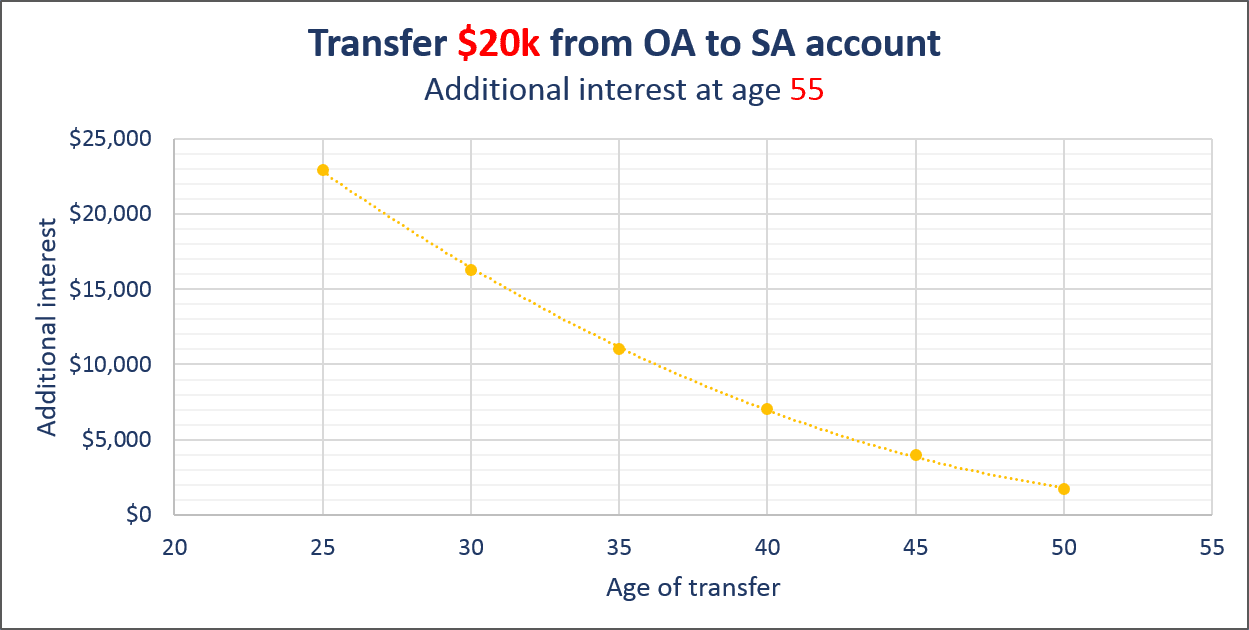
If you are interested to know the amount of additional interest you can receive at age 55, take a minute to study the graph below. A typical 30 yo working adult will earn an additional $16k in interest by age 55, if he transfers $20k from OA to SA account today. This is effectively a 80% 'returns' on your unused OA savings. If the transfer is done earlier, the amount will be higher, and vice versa.
As you can see, as your age increases, the additional interest decreases more quickly if you delay the transfer by a year. This is the power of compounding. So, to get more out of the transfer, act early, don't procrastinate.
In the graph, 55 yo is used as the reference because that is the age we can withdraw our CPF savings, after setting aside the Minimum Sum. That means, the additional interest you received can be withdraw as cash when you hit 55 years old. These are 'free' money with just a few clicks on the CPF website.
CPF website has a calculator to compute how much more interest you can get from a OA-SA transfer. Check it out here.
What is stopping us?
Okay I exaggerated, the process might be simple, but the planning behind the decision to transfer money from OA to SA account requires more brain juice. Indeed, it is not a simple decision, even Max took a few days to consider before transferring $25k of his OA savings to SA account in 2016.
So, what is making the decision so difficult. Max thinks that it all boils down to the lack of knowledge in two areas:
- Not knowing the benefits of such transfer
- Not knowing how much OA savings is required for longer term purposes (such as housing and education for kids)
If you fall under the first group, I suggest you read the previous to convince yourself on the power of compounding. For the second group, who is also the ICINI group, it is important to carefully evaluate your personal needs for the money in CPF OA account. This is important because the OA-SA transfer is irreversible, which is the main difference with downsizing your phone plan or cancelling a credit card.
How much OA savings do I need?
While the aim is not to allow your unused CPF savings to sit in the OA account earning a lower interest rate, do not also fall into a situation with insufficient OA savings to meet your needs.
To avoid that, we must know what we need, so we plan to ensure sufficiency. To understand your personal needs for OA savings, do consider some of the questions below:
- At what age do you expect to purchase/ finance your property/ education?
- What is the cost of the property/ education?
- What is the upfront payment and monthly payment required?
- Financing through CPF OA, cash or a combination of both?
- Decide whether you plan to invest using CPF? (considering that the investment product applicable for CPF SA is more limited)
Remember to also cater buffer to your plans; things does not always go according to plan. For example, if you are planning for a $300k BTO purchase at 35 yo, it's better to budget for $350k by 33 yo.
At the same time, try to give a more certain plan by avoiding vague answers such as 'maybe', 'not sure' or 'between 30 to 40 yo'. The more certain you are, the less money you need to set aside as buffer. This means less money can be transferred to SA account, and less additional interests to be earned. Get the idea?
So, should I transfer now?
There is no step by step guide out there <let me know if there are any>, but it is as straightforward as understanding your personal needs, work out the yearly expected contribution and withdrawal from the OA account, before transferring the excess to SA account. Simple, yet not so simple.
In fact, considering all aspects, it is complex enough to need a model for such computation. Max is currently working on a model to answer such questions related to wealth optimization, do subscribe to the blog to be informed when it is ready. It should take another 1-2 more weeks.
Meanwhile, why not take 10 minutes to read the CPF links at the end of the post. It will give you a better idea of how much you need for OA savings. It may give you more cash withdrawal at age 55.
Don't wait, optimize your CPF savings now.
----------
MAFIA
----------
----------
CPF overview
https://www.cpf.gov.sg/Members/AboutUs/about-us-info/cpf-overview
Interest rate for CPF savings
https://www.cpf.gov.sg/Members/AboutUs/about-us-info/cpf-interest-rates
CPF Public Housing Scheme
https://www.cpf.gov.sg/Members/Schemes/schemes/housing/public-housing-scheme
CPF Education Scheme
https://www.cpf.gov.sg/Members/Schemes/schemes/other-matters/cpf-education-scheme
Upcoming posts
3. My financial philosophy
4. Review of my 2016 stock investing performance
5. Why do I top up my CPF SA using cash
6. Big spending - Invisalign
Subscribe to:
Posts (Atom)